High-power bt PoE for AI-ready networks
Introduction
High-Power PoE (IEEE 802.3bt) represents the most advanced stage of PoE development and arrives when industrial networks are shifting toward AI-driven automation. As factories, smart cities, and mission-critical infrastructures push more computing to the edge, devices require not only higher bandwidth but also significantly higher power to support complex computing, multi-sensor fusion, advanced imaging, and real-time analytics.
Earlier PoE standards, IEEE 802.3af (15.4W) and 802.3at (30W), were not designed for this new generation of AI-enabled edge devices. Today's 4K/8K security cameras, Wi-Fi 6/7 APs, and IIoT sensors frequently exceed 30 to 60W of power consumption, creating the need for a new standard supporting the next decade of power-hungry edge equipment.
IEEE 802.3bt addresses this need by delivering up to 90W per port, and it enables:
Sufficient power for AI-enhanced vision and inference modules
Stable operation for real-time industrial analytics
Scalability deployment for AI and IIoT deployments
A standardized and backward-compatible upgrade path
In short, High-Power PoE has become a foundational element for Industrial AI-Ready Networks, where they connect smarter cameras, sensors and edge computers. This white paper explains why bt PoE is essential, how it works, and how to deploy it effectively.
Why High-Power bt PoE? Why Now?
Ratified in 2018, IEEE 802.3bt aligns directly with the acceleration of IIoT and edge AI. Prior PoE standards were limited by available power and could not meet the requirements of PTZ cameras, robotics, LED lighting, RFID readers, or HD/4K displays. Power dissipation further constrained deployments. For example, an 802.3af PSE can supply 15.4W, the PD receives only 12.95W. The table below shows the effective power a PD receives under different PoE standards.
From 15.4W to 90W, PoE evolves to power high-performance industrial and AI devices
Benefits of the High-Power bt PoE Standard
Higher Power Budget and Broader Compatibility
The IEEE 802.3 framework defines PoE power levels using Classes 0 to 8, enabling precise power budgeting and interoperability between PSEs and PDs. IEEE 802.3bt (Type 3/4) supports Class 5–8 and remains fully backward compatible with 802.3at/af, allowing mixed-generation devices to operate within the same network.
IEEE 802.3bt Type 4 supports PoE Classes 7–8 and is backward compatible with 802.3af/at.
Optimized Power Management Through PD Type Recognition
IEEE 802.3bt introduces several enhancements that improve PoE predictability and efficiency:
Single- vs. Dual-Signature PDs:
Single-signature PDs use one classification circuit, while dual-signature PDs separate power to functional modules such as heaters and PTZ motors.
Connection Check:
bt PoE can distinguish between these PD types. This is something af/at could not do.
Autoclass:
Enables the PSE to measure a PD's actual power draw for more accurate budgeting in multi-port deployments.
Together, these enhancements improve system stability and enable more efficient use of available power resources.
Key Applications Enabled by High-Power PoE
With up to 90W per port, High-Power PoE supports edge devices that previously required local power sources:
PTZ & AI-Enhanced IP Cameras: Motors, IR, heaters, and onboard AI modules often exceed 30 to 60W. High-Power PoE ensures full functionality via a single cable.
LED Lighting & Smart Buildings: High-Power PoE can power advanced luminaires and control modules, while reducing standby consumption for greater energy efficiency.
Wi-Fi 6/7 Access Points: Multi-radio APs often require 60W+ for sustained throughput. The bt PoE supports stable operation without external power.
Next-Generation IIoT Sensors: Sensors with local processing, wireless modules, or multi-function capabilities now rely on bt PoE for stable, centralized power delivery.
Choosing an 802.3bt Industrial PoE Switch
Deploying bt PoE requires careful evaluation of PD power requirements and overall switch power budget. Both the PSE and PD must be compliant with IEEE 802.3bt to ensure safe and predictable operation.
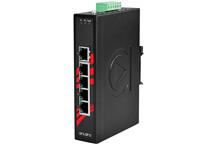
Although many vendors advertise 802.3bt compatibility, some only support Type 3 (60W). Antaira provides full Type 3 and true Type 4 (90W) power across industrial managed switches, unmanaged switches, injectors, and media converters. Flagship examples include theLMP-1204G-SFP-bt-T, a 12-port Gigabit Layer 3 Lite managed switch capable of delivering Type 4 power across multiple ports.
Across its portfolio, Antaira's high-power PoE solutions offer:
Robust industrial performance
Full IEEE 802.3bt compliance
Up to 100W per port for high-power PDs and future-proof deployments
Support for high-density, multi-device deployments
Over 200 models across nine product lines for diverse industrial environments
Enhanced Reliability Through Patented PoE Mechanisms
To address practical challenges in field deployments, Antaira incorporates several patented mechanisms throughout the system lifecycle to improve operational robustness. These include long-distance remote recovery, automatic adjustment of power budgets when input voltage varies, uninterrupted PoE during firmware upgrades, and controlled power-off to prevent electrical arcing during cable removal.
Antaira bt PoE incorporates patented mechanisms throughout the power device lifecycle to deliver safe, reliable and resilient networking performance.
Conclusion
High-Power bt PoE (up to 90W) significantly expands what can be deployed at the network edge. With 4-pair powering, improved efficiency, and backward compatibility, IEEE 802.3bt Type 4 has become a core enabler for modern industrial, smart building, and IIoT infrastructures.
As power demands continue to rise, Antaira's comprehensive High-Power PoE solutions help ensure that industrial networks remain reliable, scalable, and ready for the next generation of edge intelligence. More about Antaira PoE solutions.
https://www.antaira.com.tw/img/whitepaper-file/Antaira_Whitepaper_High-Power%20Delivery%20for%20Industrial%20AI-Ready%20Networks.pdf
 RSS
RSS
Czytaj także
-
Jak dodać funkcję rejestrowania plików procesowych? Zapisywanie danych | Kurs...
Chcesz nauczyć się programować panele HMI? Weź udział w bezpłatnym kursie. Wszystkie odcinki i materiały dodatkowe znajdziesz na stronie: ...
-

Kluczowa rola wycinarek laserowych w obróbce metali
Wycinarki laserowe zrewolucjonizowały przemysł obróbki metali, oferując niezwykłą precyzję i efektywność. Dowiedz się, dlaczego są one...
-

-
-
-

-
-